
Free multiplication game for kids
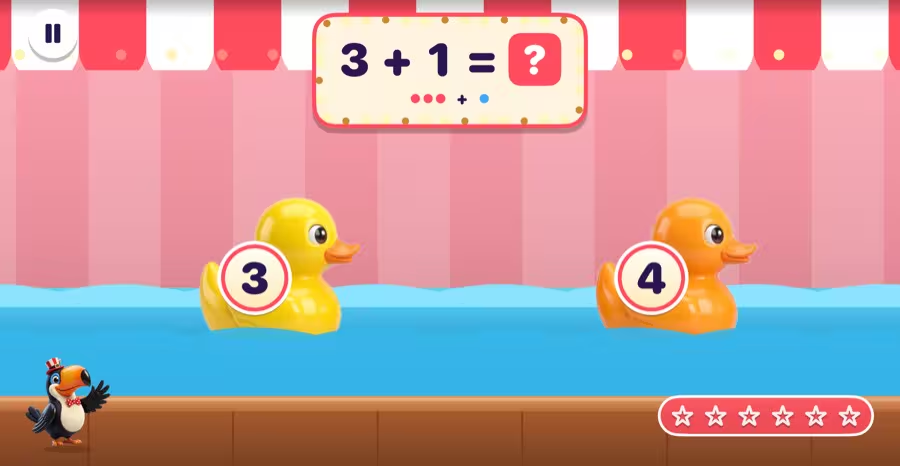
Practice one times table at a time, from ×1 to ×12, or mix them all. Tap the duck with the product and the hook reels it in.
Multiplication Duck Pond
Pick a times table
10 ducks a round · no sign-up · nothing is saved
Multiplication Duck Pond
Catch the duck with the answer!

Filling the duck pond…
The game didn’t load. Check your connection and try again.
Round complete!
This game needs a newer browser (Safari 16 or later, or a current Chrome, Edge or Firefox).
Free to play · no sign-up · no ads · sound starts only after you tap
How to play
- Pick a times table. Start with an easy one, or choose Mixed 1–12 to practice them all.
- Read the problem on the sign. In the easiest problems, dots under the numbers let your child count to the answer.
- Tap the duck with the answer. The fishing hook swings in and reels it out of the pond.
- Missed one? Try again. The duck slips back into the water with a gentle “So close!”. After two misses the right duck glows.
- Finish a round of 10 to earn up to three stars, then play again or move up a level.
What it practices
| Level | Grades | Skills |
|---|---|---|
| ×1, ×2, ×5, ×10 | Grades 2–3 | The easiest tables first: doubles and skip counting by 5s and 10s. Small facts show groups of dots so multiplication looks like equal groups (3.OA.A.1). |
| ×3, ×4, ×6 to ×9 | Grade 3 | The facts children are expected to know from memory by the end of 3rd grade (3.OA.C.7), with turnarounds like 4 × 7 and 7 × 4 mixed in (3.OA.B.5). |
| ×11 and ×12 | Grades 3–4 | Beyond the standard, but taught in many schools and handy for later work with measurement and money. |
| Mixed 1–12 | Grades 3–4 | All tables shuffled together, the best check that facts are really memorized (4.OA.B.4 builds on these facts). |
Tips for parents
- Go in an easy order: 2, 10 and 5 first, then 3, 4 and 9, then 6, 7 and 8, and finally 11 and 12. Each new table reuses facts your child already knows.
- Use turnarounds. Once your child knows 3 × 8, they also know 8 × 3, which cuts the number of facts to learn almost in half.
- Build hard facts from easy ones: 7 × 8 is 7 × 4 doubled, and 6 × 7 is 5 × 7 plus one more 7.
- Practice one table until a round earns three stars, then switch to Mixed 1–12 to make sure the facts hold up out of order.
Frequently asked questions
Which times table should my child start with?
Start with ×2, ×10 and ×5. They follow patterns children already know from skip counting, and they make the harder tables easier later on.
Can I link straight to one times table?
Yes. Add ?table= and a number to the address, for example /games/multiplication/?table=7 opens the game with the 7 times table selected.
How do I know the facts are memorized?
When your child finishes Mixed 1–12 rounds with three stars, meaning nine or ten answers right on the first try, the facts are close to automatic. Under the national standards that is the goal by the end of 3rd grade.
Is there a timer?
No. Speed comes from practice, not pressure. There are no timers and no way to lose; a wrong answer just gets a gentle “So close!” and another try.
Is the multiplication game free?
Yes. It runs in your browser with no sign-up, no ads and no downloads, and nothing is saved or sent anywhere.
What does the Mathing app add?
The Mathing app for iPhone and iPad covers every times table in 20 multiplication levels across five carnival booth games, brings back missed facts until they stick and shows grown-ups which facts still need work.